Impact of Google’s AI Overviews on Website Traffic and Zero-Click Searches
AI Overviews cut clicks to the top-ranking page by 58%. Here’s the latest data on zero-click search and what it means for your content strategy.

Written by Nik
Founder & CEO, Get Stuff Digital
Published
7 min read
The shift towards an “answer engine” model, as some describe it, has been a gradual evolution for Google, with AI Overviews representing a significant leap in this direction. What started as an experiment called the Search Generative Experience (SGE) is now a core part of Google Search, joined by AI Mode, Google’s fully conversational AI search experience.
With generative AI now embedded in Google search, SEO professionals have been closely watching its effects on website traffic and the rise of zero-click searches (queries where the user doesn’t click through to any external site).
Global search trends indicate an increase in on-page answers and a decrease in outbound clicks from Google to websites. AI Overviews are now available in more than 200 countries and territories and over 40 languages, and the UK now has an even higher zero-click rate than the U.S.
Let’s dive into the latest quantitative data from SEO research firms to see precisely how AI search is reshaping organic traffic, CTR, and conversions.
What is the Impact of Google’s AI Overviews on Traffic and Click-Through Rates?
Zero-click searches were the norm even before AI Overviews: in 2024, nearly 60% of U.S. Google searches ended without a click. AI has pushed that even further, with 68% of U.S. Google searches ending without a click.
AI Overviews now appear on roughly 4 in 10 U.S. desktop searches, continuing Google’s trend of keeping engagement within its own ecosystem, and even fewer people are clicking through to websites.
This means users get what they need at the top of the page and often don’t scroll any further. When an AI Overview is present, the top-ranking page now sees a 58% lower click-through rate.
This change has affected informational sites, affiliates, and product review content the most, which were the types of pages that previously dominated top-of-page rankings. Even being #1 in organic results now often means being hidden below the fold.
Our modest sample as an SEO agency across eleven of our ongoing clients also suggests a 20-35% drop in organic traffic since AI Overviews rolled out.
Only a small handful of “chosen” sources get featured in the AI Overview itself, and those few are now essentially in a new kind of “Position 0.”
How Do People Search, Research, and Buy in the Age of AI Search?
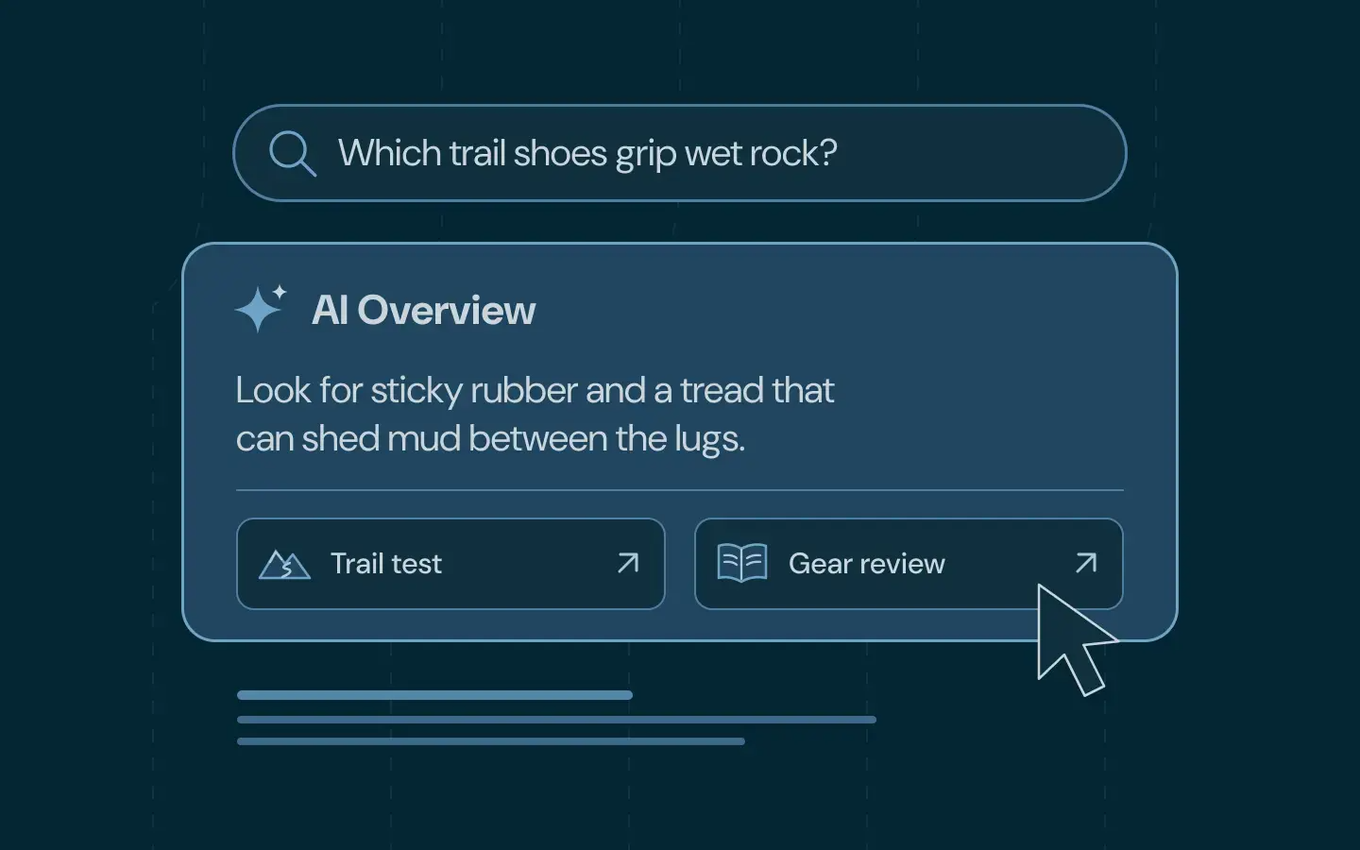
When people search on Google today, especially for informational or product-related queries, they’re immediately met with a large, AI-generated summary at the top of the page.
This AI overview result does the job of summarizing key points, offering definitions, comparisons, and even listing product options with pros/cons.
For many users, the overview gives them enough information that they no longer feel the need to click through to a website. Independent studies put the drop in organic CTR at around 58–61% when an AI Overview is present.
If your link is below that box, there’s a good chance it never even gets seen because Google has become the answer.
But not all hope is lost: users still click, just far less and far more selectively. It definitely means less traffic, but the people who do click have already read a summary and chosen to go deeper.
Google says these are higher-quality clicks, with users less likely to bounce straight back. Adobe also found that shoppers arriving at U.S. retail sites from AI tools like ChatGPT converted 60% better than non-AI traffic in July 2026, the eleventh month in a row they’ve outperformed.
Clicks Still Happen, But Only If You’re In the Answer
When a user does want more information, especially about a product, they’re most likely to click one of the few sources linked inside the AI answer.
Being one of these cited sources makes a huge difference. Seer Interactive found that being cited in an AI Overview delivers about 120% more organic clicks per impression than not being cited on the same results page. Seer’s own breakdown, per million impressions on informational queries, works out to roughly:
- No AI Overview present: ~33,500 organic clicks
- Your brand cited in the AI Overview: ~20,743 organic clicks
- AI Overview present, your brand not cited: ~9,445 organic clicks
A citation won’t restore pre-AI traffic levels (cited pages still get about 38% fewer clicks than results on searches with no AI Overview), but it’s the best position available when an AI Overview appears. And the visitors it brings have already read a summary and chosen to dig deeper.
Product Discovery Is Now Filtered Through Google
Product research hasn’t disappeared, but it’s more tightly controlled by Google.
AI Overviews now present product roundups, complete with specs, use cases, and basic recommendations, and they’re spreading fast across commercial searches. In a recent study, Semrush has highlighted how AI Overviews appeared on 88% of tracked commercial keywords, nearly double the year before.
This effectively turns Google into the first phase of shopping: a curated, trust-based product research hub.
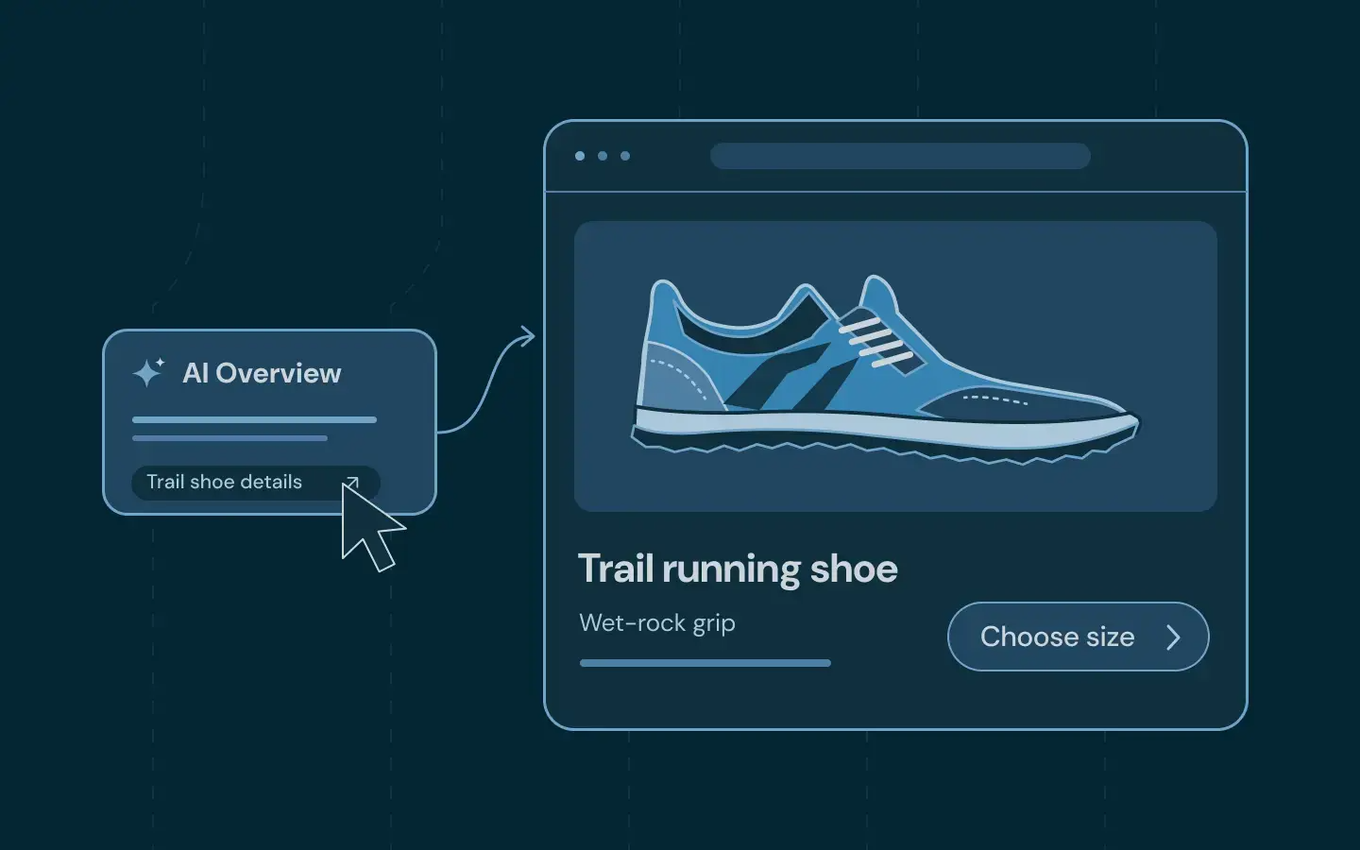
Instead of typing “best trail running shoes” and scrolling through 10 blogs, a user now reads a clean comparison generated by Google’s AI, often quoting top e-commerce or review sites. If your brand or product is one of those listed, you may get the click. If not, your blog post or listicle likely gets skipped.
Google is now moving into checkout, too. Its Universal Cart, launched in the U.S. in October 2026, lets shoppers add products to a cart and pay with Google Pay directly from Search and the Gemini app, though they can still choose to finish on the merchant’s site.
What Does This Mean for Websites?
Even though all of this might sound like bad news for websites, they’re not going anywhere, especially the ones that make it onto Google’s shortlist:
- Websites are now data sources, not just destinations. If your site is authoritative, clear, and well-structured, it may be cited in AI Overviews, which can lead to increased traffic and conversions. Rankings help, but they’re no longer enough on their own: only 38% of AI Overview citations come from pages ranking in the top 10, down from 76% in mid-2025.
- They’re still where most decisions get made. Google can now show prices and, in the U.S., even handle some checkouts, but sign-ups, demos, quotes, account creation, and bigger or more complex purchases still happen on your site.
- They must adapt content to AI: summaries, structured data, unique insights, specifics, and experience-rich writing have a better chance of being picked by the AI.
- They must compete for inclusion, not just ranking. It’s no longer about being result #1, it’s about being selected.
Where Do Organic Clicks Still Happen?
Not every search is equally affected. Seer Interactive found that on informational queries where Google doesn’t show an AI Overview, organic CTR actually rose during 2025, from 2.93% to 3.97%.
According to Seer, this is likely because AI Overviews absorb the quick-answer searches, so the ones left over skew toward people who genuinely want to click through, often because there’s no single universal answer to their question.
Future Outlook and SEO Strategies Going Forward
The era of the “10 blue links” is over. While traditional organic listings will not disappear overnight, the trend is clearly toward richer, AI-driven results occupying prime real estate. As large language models improve and Google integrates them further, we can expect zero-click searches to remain dominant.
AI Mode Is the Next Shift
AI Mode, Google’s fully conversational search experience, passed one billion monthly users within a year of launch, with queries more than doubling every quarter. Google is also adding AI agents to Search that monitor topics in the background and help book local experiences and services on a user’s behalf.
For now, AI Mode isn’t what’s driving the rise in zero-click searches: only 0.34% of searches moved into AI Mode in early 2026, but its growth rate suggests it could drive the next wave.
Content Still Wins, But the Bar Is Higher
The future of websites and SEO is no longer about driving traffic but about earning trust and relevance in an AI-powered search experience.
Traditional blog posts that once attracted users and funneled them toward conversions are losing visibility in a landscape dominated by zero-click searches. AI Overviews now answer many questions instantly, bypassing websites entirely. Being cited as a source for a generic fact rarely earns a click, but it isn’t worthless either.
The new SEO battleground is product-focused, highly specific, and intent-driven queries. People no longer need to search with vague keywords. Instead, they can ask full, nuanced questions like “Best all-season tires for a compact car that mostly drives short distances?”
So the content that wins in this environment isn’t simply the content that ranks for a keyword. It’s the content the AI decides to trust and cite, and the content worth clicking when someone wants to go deeper. To win here, your content must solve real-world needs with depth, clarity, and specificity. That means less chasing keywords, and more understanding of people’s actual needs.
Content that earns citations and clicks today takes into account:
- The real intent behind long, specific questions, not just the head keyword
- First-hand experience and original insight the AI can’t find anywhere else, such as testing, proprietary data, or expert opinion
- Structure that’s easy to extract, with clear answers, comparisons, and specifics
- Strong rankings, since AI Overviews mostly cite pages that already rank well
- Presence beyond your own site, on YouTube, Reddit, review platforms, and the “best of” lists AI tools draw from
- Freshness, so the AI isn’t citing outdated information about your product or category
- The searches AI doesn’t answer well, where there’s no single universal answer and users still click